What if your helmet had blindspot detection so you can ride safely?
Skills
Interaction Design
Spatial Computing
Prototyping
Physical Computing
Tools
Unity
Arduino
Meta Quest 3
Team / Instructors
Felix Lorsignol
Hun Han
Sahil Islam
David Rose
Ricardo Acosta
Duration
5 days, 2025

Concept
Lume is an AR system for motorcycle helmets that closes a rider's blind spots without asking for their attention. Built as a VR simulation in Unity, it recreates real road conditions to show how the system performs in real time, surfacing alerts and ride data directly in a rider's line of sight, so nothing pulls their eyes from the road.
Subtle over prominent
We were tasked with designing a spatial computing product for transportation. Motorcycle helmets create real blind spots, and our first instinct was to use the helmet's transparent windshield as a display surface.
Interviews with three motorcyclists changed our direction. Riders wanted subtle information, not prominent graphics: anything too visible risked pulling focus from the road. A research paper we found backed the instinct: explicit cues distract people. Lume needed to inform without demanding anything.


Interaction Model
A red light flags a vehicle the moment it enters a rider's blind spot, tuned through testing to register without alarming. Speed and fuel sit quietly at the edge of view.
Making the System Real
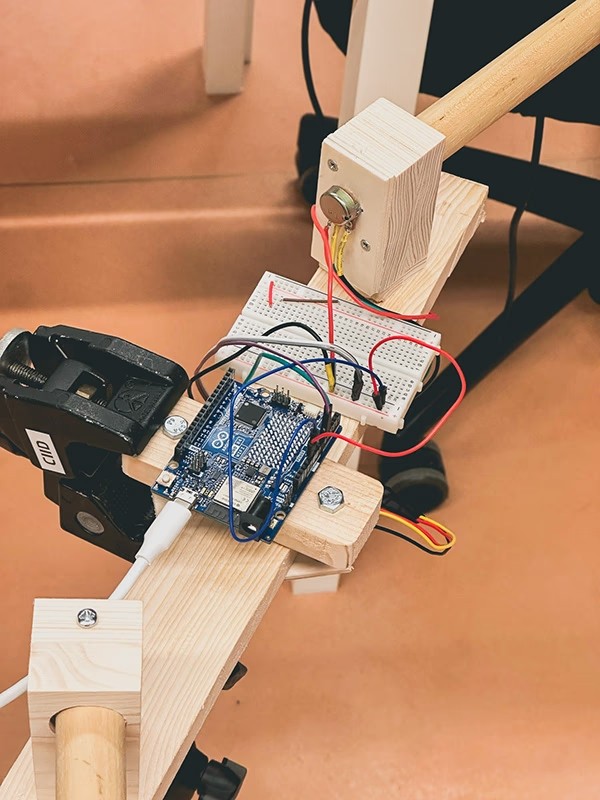
We built a testing environment integrating Unity, Arduino, a potentiometer, and a Meta Quest 3. A physical handlebar, wired through Arduino, let riders steer and control speed with their hands instead of a controller, closing the gap between simulation and the feel of actually riding.

Live Demo

