What if your home was a radio host that knew when you were scrolling instead of living?
Skills
Interaction Design
Computer Vision
Prompt Engineering
Physical Computing
Tools
Cursor
Arduino
ElevenLabs
Teachable Machine
Team / Instructors
Juan Ignacio Garro
Alec Davis
Bjorn Karmann
Matteo Loglio
Duration
4 days, 2025
Challenge
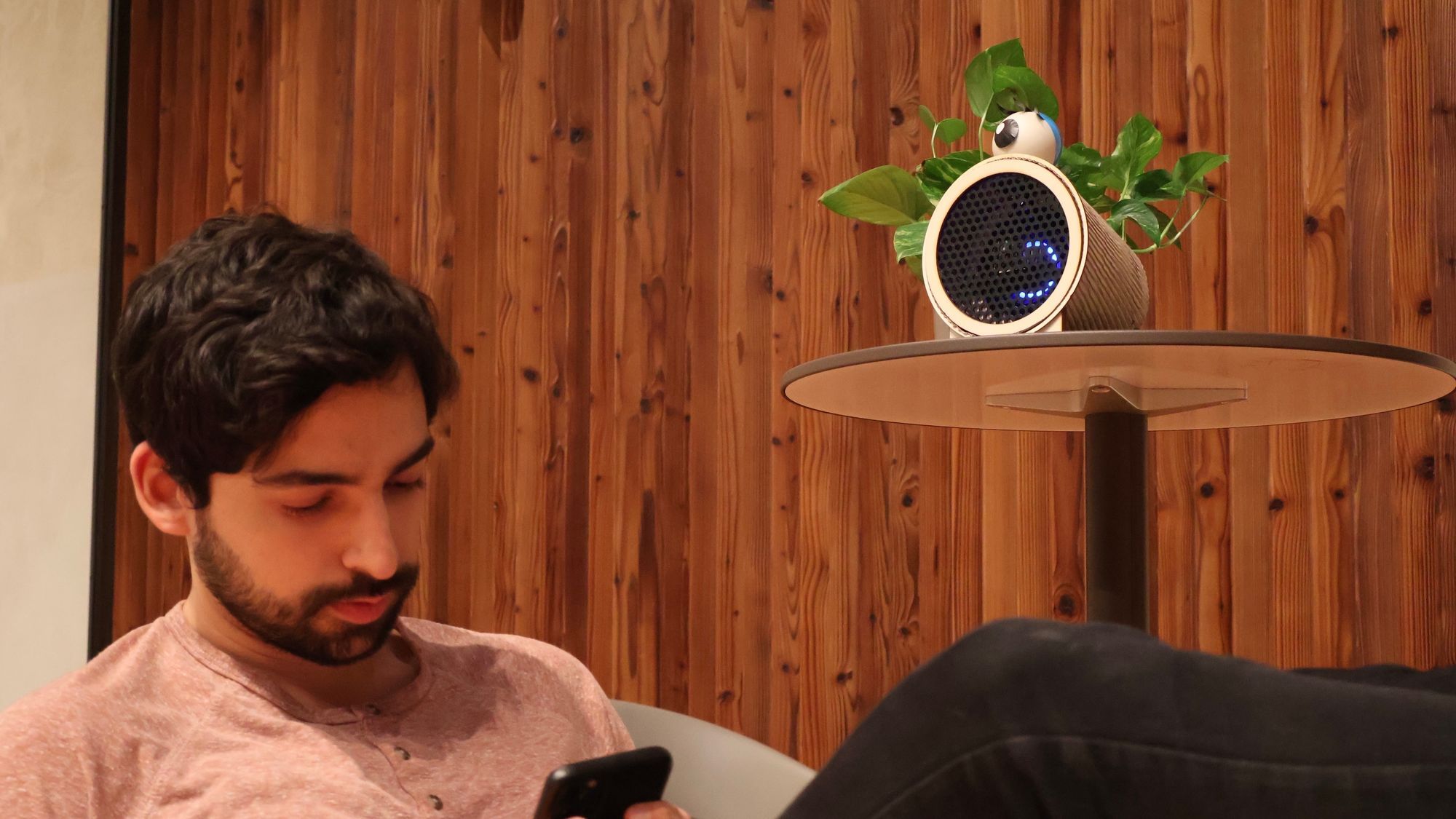
Living.fm emerged from our team's desire to be more intentional about free time at home. While routines shape who we are, many everyday habits, like endless scrolling, are reinforced by technology designed to capture attention. We explored how self-awareness could act as gentle friction to interrupt these patterns. The result was Liv, a portable AI narrator that pairs ambient music with intermittent, slightly sassy, contextual commentary.
Designing Living.fm
We created Living.fm, a speculative product featuring Liv, a portable home narrator that pairs ambient music with fun, contextual commentary. Liv responds to the your behaviors, offering encouragement for certain activities, like cooking or stretching, or lightly roasting you for less desirable ones, like doom-scrolling.

Bodystorming Everyday Routines
As a team, we bodystormed everyday moments, collapsing on the couch, stretching between tasks, scrolling, sharing space, to understand when interruption feels supportive versus annoying. These enactments revealed a key insight: timing matters more than content. Too early feels intrusive, too late feels pointless. This directly shaped Liv's behavior, especially when she should stay silent.
Behavioral Logic
I trained the Teachable Machine model to recognize our sample movements, wrote the prompts that shaped Liv's personality and responses in Cursor and ElevenLabs, and built a testing interface that let us see what Liv was seeing and would say in real time. She recognizes simple physical activities through a webcam and responds with commentary, sometimes helpful, sometimes sassy, always present. While the original plan was to have her comment on any type of activity, consistency issues led us to stick with several specific scenarios for the purpose of the prototype.

We used Google's Teachable Machines to train a machine learning model that recognizes our sample movements.


Sample code of Liv's state machine & responses
Seeing What the System Sees
In an ambient system, the interpretation is the product. Before we could trust Liv's responses, we needed to see her reasoning. I built a live testing interface exposing the system's real-time behavior classification for our core scenarios including Idle, Doomscroll, Yoga, Dancing. Getting visibility into her perception, not just her output, let us catch misclassifications early and calibrate trust.

Testing out system classification and then building visibility into how the machine determines classification
Reflection
In Korean, 잔소리 (jansori) describes nagging that overwhelms care with repetition. This surfaced during prototyping and user testing, when our initial interventions felt intrusive.