What if you had to design for a non-human species?
Skills
UX Research
Biomimicry
Team
Eva Barth
Leon Fan
Vedant Jain
Wayne Kim
Course
Designing across Biological Scales
5 days, 2024
Instructors
Norris Hung
Rebeca Mora
Challenge
Larvae Lagoon addresses challenges facing dragonfly habitats in the Astino Valley, where increasing droughts and floods threaten ecological stability.
Through ecological research, field observation, biomimicry-inspired design, and feedback from subject matter experts, we developed a modular habitat concept designed to support dragonflies under changing water conditions.

Why Dragonflies Matter
Dragonflies act as bioindicators of ecosystem health. Their presence signals clean, oxygen-rich water and stable riparian systems, linking aquatic and terrestrial food chains across multi-year lifecycles.
However, dragonflies are under threat, with 16% of species at risk of extinction due to habitat loss, pollution, and climate change. Wetlands, essential to dragonflies and other species’ survival, are disappearing three times faster than forests, underscoring the urgency of conservation.
As climate change accelerates habitat loss and water volatility, designing for dragonflies becomes a proxy for supporting broader ecosystem resilience, not just a single species.
Location of Intervention
The Astino Valley near Bergamo and the CIID campus contain a network of streams, ponds, and wetlands that support multiple dragonfly species, including Cordulegaster boltonii. These dragonflies depend on stable water flow, dense riparian vegetation, and consistent oxygen levels for stable habitats and reproduction.
Seasonal extremes increasingly disrupt these conditions. Summer droughts reduce water flow and oxygen availability, while periods of heavy rain cause flooding, erosion, and vegetation loss. Together, these pressures destabilize dragonfly habitats across the valley.


Research & Insights
Desk research, field observation, and expert conversations grounded our understanding of dragonfly habitats and water systems.
We reframed the problem from protecting a single habitat to supporting resilience across extreme conditions.


We reframed the problem from protecting a single habitat to supporting resilience across extreme conditions.

Key Insights
Dragonfly habitats require stable, oxygen-rich water across long larval lifecycles
Drought and flooding create interconnected risks that compound habitat degradation
Site conditions vary significantly, requiring adaptable and site-specific interventions

Translating ecology into design
We studied how ecosystems manage water, stability, and resilience under stress to inform design principles.
Store water during drought

Inspired by bromeliad leaves that collect and retain rainwater.
Regulate water flow during flooding & stabilize structures in fluctuating water
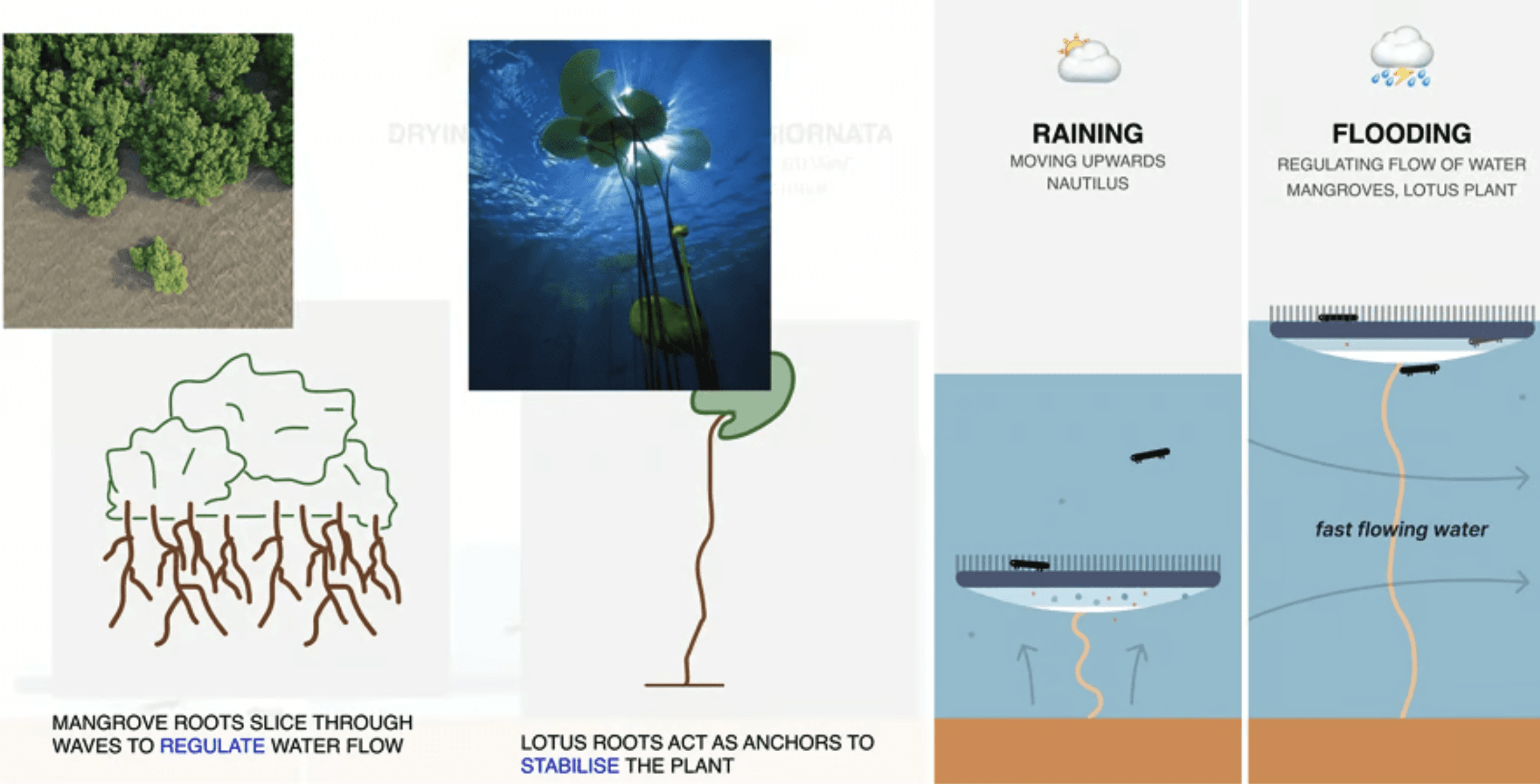
Inspired by mangrove root systems that slow water and stabilize soil and llotus anchoring systems that maintain balance as water levels change.
Expert input and refinement
After developing the initial concept and prototype, we shared the work with local ecological experts specializing in Bergamo’s fauna. The prototype served as a discussion tool to examine species needs, habitat placement, and long-term impact.
Expert input reinforced the importance of addressing both drought and flooding and helped clarify where adaptive interventions could have the greatest ecological value. These conversations informed the next iteration of the concept.

Reviewing the prototype and research with local ecological experts

Discussing site conditions and habitat placement in Astino Valley
“The approach is very stimulating and worth continuing. We encourage you to develop it further.”
-Local ecological expert, Bergamo
Concept
We developed a modular habitat prototype designed to respond to both drought and flooding.
The system supports:
Water retention and oxygen-rich conditions during drought
Structural stability during flooding
Adaptation to different site conditions and species needs
Modularity allows the system to be reconfigured rather than optimized for a single scenario.

Learnings
Designing for non-human users requires longer time horizons and different measures of success
Ecological systems thinking reveals interdependencies that support resilient solutions
Collaboration with biologists and ecologists strengthens design decisions
Reflections
Designing for dragonflies reframed how we define users, impact, and responsibility.
By treating non-human species as stakeholders and working through a systems lens, this project shows how small, thoughtful interventions can support long-term ecological resilience.